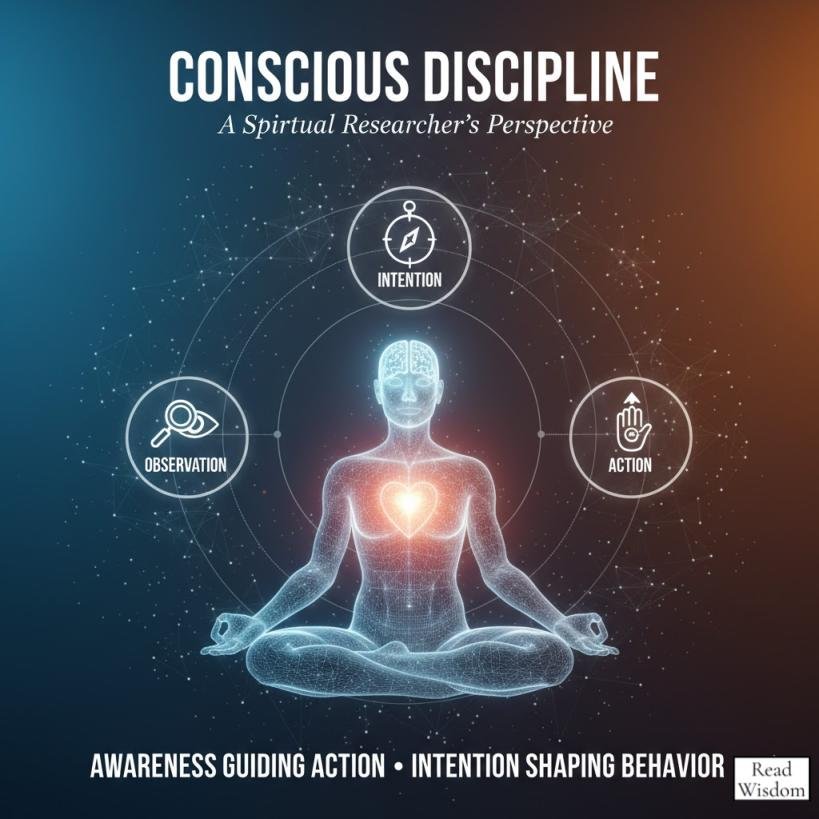
In an age where impulsivity often overshadows awareness, conscious discipline emerges as both a spiritual and psychological compass—a way to harmonize our inner world with our actions in the outer one. The term may sound modern, yet its essence traces back to the ancient wisdom that emphasized mastery over the self as the foundation of freedom. Simply put, conscious discipline is not about control for control’s sake; it’s about awareness guiding action, intention shaping behavior, and consciousness directing will.
Through this lens, conscious discipline becomes less a rigid system of self-restraint and more a living practice of awareness-in-action—one that aligns our thoughts, emotions, and actions with clarity, compassion, and higher purpose.
The Roots of Discipline and Consciousness
To truly understand conscious discipline, we must first separate the two layers that compose it: discipline and consciousness.
- Discipline, in most interpretations, means structure, self-control, and order. It involves doing what must be done even when it’s uncomfortable. From a material standpoint, discipline is the backbone of success, allowing goals to be achieved through consistency.
- Consciousness, by contrast, is the awareness principle—the observer within that perceives our life experience. It is the silent intelligence underlying thought, feeling, and perception. It is what allows us to reflect on our own behavior, to sense alignment or dissonance, to grow inwardly.
When these two meet, they form a profound alchemy. Discipline alone can become mechanical—habit-driven and externalized. Consciousness alone can remain abstract—rich in insight but poor in manifestation. The union of both leads to conscious discipline, a state where awareness infuses structure and structure supports awareness.
This is the quiet art of living deliberately.
Conscious Discipline vs. Mechanical Discipline
To illustrate this difference, consider two individuals following the same daily routine—rising early, meditating, exercising, working, and resting at set times. Externally, their days seem identical. Yet one performs these tasks from habit or obligation, while the other performs them from awareness, using each moment as an opportunity to observe inner states, to act with intention rather than compulsion.
The first is mechanical discipline: action without presence.
The second is conscious discipline: presence within action.
This small shift transforms everything. Conscious discipline does not restrict; it liberates. It allows the individual to move from unconscious reactivity to conscious responsiveness. Where mechanical discipline demands obedience, conscious discipline invites participation—an active engagement with life’s rhythms rather than resistance to them.
The Spiritual Foundation of Conscious Discipline
Every major spiritual tradition offers versions of conscious discipline. In yoga, it’s called tapas—the sacred fire of self-regulation undertaken with awareness. In Buddhism, it’s the cultivation of mindfulness and right effort. In Stoicism, it’s the art of self-mastery guided by reason. The common thread among these traditions is the understanding that real freedom does not come from doing whatever we please, but from being free enough not to be enslaved by our impulses.
A spiritual researcher studying these traditions may observe that conscious discipline is a universal human practice aimed at the same goal: the alignment of energy, attention, and intention. Through it, we refine our perception and purify our motivation. We learn to transcend habitual patterns and touch the still center of awareness from which authentic action flows.
One could say conscious discipline is a form of spiritual hygiene. Just as we cleanse the body daily to maintain health, conscious discipline cleanses the inner field of attention to maintain harmony between thought, feeling, and deed.
The Psychology Behind Conscious Discipline
Though its roots are spiritual, conscious discipline harmonizes beautifully with modern psychology. Self-regulation theory, emotional intelligence frameworks, and mindfulness-based cognitive practices all point to the same principle: sustainable transformation occurs only when awareness leads the process.
For instance:
- Self-awareness allows us to notice the gap between intention and behavior.
- Self-regulation enables us to pause between stimulus and response.
- Motivation keeps purpose alive when emotions fluctuate.
In traditional models of discipline, willpower is the engine. In conscious discipline, awareness is the driver. We use willpower not to suppress impulses but to illuminate them—to see their origins and decide consciously whether to act upon them.
This conscious observation brings us closer to self-understanding, which in turn reduces self-conflict. Over time, discipline shifts from something imposed externally to something that flows naturally from inner clarity.
Conscious Discipline in Everyday Life
Let’s bring this from principle into practice.
- In Decision-Making:
Conscious discipline invites us to pause before choice—whether it’s what to eat, how to speak, or where to direct attention. The pause allows awareness to intervene, transforming habit into choice and choice into alignment. - In Emotional Management:
When anger, fear, or jealousy arise, conscious discipline does not repress them. It observes them without judgment and responds responsibly rather than reactively. Over time, emotions become signals rather than saboteurs. - In Work and Relationships:
Practicing conscious discipline means showing up with presence and integrity, engaging fully with tasks and people, and maintaining the balance between effort and ease. It involves discipline to focus, but with the consciousness to stay open and adaptable. - In Spiritual Growth:
Meditation, prayer, or self-inquiry all require a disciplined rhythm—but these practices come alive only when infused with awareness. Conscious discipline makes spiritual practice a living reality rather than a mechanical ritual.
Through these day-to-day acts, consciousness integrates with activity, making life itself the practice ground.
The Inner Mechanics of Conscious Discipline
From a researcher’s standpoint, conscious discipline can be described as the synchronization of three internal movements:
- Observation: Noticing the tendency or impulse without judgment.
- Intention: Choosing alignment with values or higher purpose.
- Action: Executing the choice with clarity and commitment.
This triad transforms ordinary experience into conscious living. Over time, these micro-practices replace inner chaos with coherence. The more one practices, the less inner friction there is between “what I should do” and “what I actually do.”
Spiritually, this coherence strengthens what many traditions call sattva—a state of inner equilibrium marked by clarity, calm, and quiet joy. Psychologically, it enhances self-efficacy and emotional resilience.
The Challenges on the Path
Practicing conscious discipline is not a linear journey. Awareness wavers. Habits reassert themselves. The ego resists what threatens its comfort. Yet these moments are not failures—they are invitations to practice presence again.
The key challenge lies in remembering—to bring consciousness back to the surface when old programming takes hold. Ironically, even forgetting is part of the learning cycle; each lapse reveals where unconscious patterns still dominate. Over time, the returning to awareness becomes easier, almost automatic.
Patience is vital here. Conscious discipline unfolds not by force but through gentle, consistent return—return to awareness, to intention, to the heart of being.
Conscious Discipline as a Form of Love
At its deepest level, conscious discipline is an act of love—love for one’s own evolution, for truth, for the harmony that connects all things. When a person commits to awareness-born discipline, they are essentially nurturing life’s intelligence within themselves. They become co-creators with consciousness rather than subjects of conditioning.
This kind of love has nothing to do with sentimentality. It expresses itself through thoughtful choices, meaningful silence, responsible action, and compassionate restraint. It is love that respects both the freedom and responsibility that come with awareness.
Integrating Conscious Discipline in the Modern World
In our hyper-stimulated, distractible age, conscious discipline is not just a personal virtue—it is a necessity. Everywhere we look, attention is fragmented; desire is amplified; stillness is rare. Conscious discipline reclaims sovereignty over that lost attention.
Simple integration practices might include:
- A few minutes of mindfulness before starting work each morning.
- Conscious digital habits, like setting boundaries for screens and notifications.
- Reflective journaling at the end of the day to observe actions without judgment.
- Practicing pauses in conversation to respond rather than react.
Each of these acts rewires neural patterns toward awareness and choice. Gradually, life shifts from unconscious automation to conscious creation.
The Evolving Understanding
From the standpoint of spiritual research, conscious discipline continues to evolve. Neuroscience now validates what mystics have long intuited: awareness changes the architecture of the brain. Mindful practice strengthens the prefrontal cortex, enhancing attention, compassion, and emotional balance—the neurological basis of conscious discipline itself.
Thus, what began as spiritual wisdom now finds confirmation in scientific research. The bridge between ancient and modern understanding grows sturdier each year, emphasizing the same truth: awareness and discipline are not opposites but partners in human evolution.
Closing Reflection
Ultimately, conscious discipline is not an external rulebook but an inner artistry. It is a way of living that brings mindfulness into motion and intention into every act. It does not reject spontaneity—it refines it. It does not suppress desire—it clarifies it. And it does not ask us to become perfect—it asks us to be awake.
The practice of conscious discipline transforms ordinary living into a path of self-realization, where each breath, each thought, each choice becomes a sacred act of awareness. That is its promise—and perhaps its quiet revolution.