In a world constantly pulling our attention outward—with endless notifications, social comparisons, and external measures of success—the idea of “focusing on self” might sound either indulgent or selfish. But there’s a deeper wisdom hidden here. True self-focus isn’t about narcissism or withdrawal; it’s about grounding oneself in awareness, rediscovering direction, and nurturing a meaningful relationship with the inner world that shapes every external action.
As a spiritual practice, when one genuinely learns the right way to focus on self, life’s noise settles into harmony, and clarity emerges naturally. This inward journey doesn’t isolate you from the world—it connects you to it more authentically.
Understanding What It Means to Focus on Self
To “focus on self” does not mean rejecting responsibilities or disregarding the needs of others. It means turning the lens inward—understanding your thoughts, emotions, motivations, and limitations. It’s choosing to become conscious of how you respond to the world rather than reacting unconsciously to it.
Spiritual traditions across ages—from the Upanishads and Buddhist teachings to Stoic philosophy and modern mindfulness—have emphasized self-awareness as the first step toward inner peace and outer effectiveness. The Bhagavad Gita calls this Atma-Vichara (self-inquiry), while the Stoics framed it as knowing the controllable versus the uncontrollable.
Thus, to focus on self is to inquire within:
- Who am I beneath the expectations and roles I play?
- What truth guides my decisions?
- Am I reacting from fear or responding from wisdom?
These are questions that realign the mind to the present moment and root it in purpose rather than impulse.
The Wrong Way: When ‘Self-Focus’ Becomes Self-Obsession
Before diving into the right practices, it’s important to highlight what not to do. There’s a subtle line between healthy introspection and self-centeredness. When focus becomes fixation—when we start constantly analyzing or judging ourselves—it becomes counterproductive.
True self-focus creates expansion, not contraction. It liberates you from ego’s grip, instead of reinforcing it. A spiritually mature focus on self seeks inner understanding so that one may serve, create, and connect more meaningfully. Self-obsession, on the other hand, breeds insecurity and disconnection.
The Right Way to Focus on Self
The “right way” is not a single method—it’s a harmony of approaches that nurture awareness across body, mind, and spirit. Here are seven foundational practices that embody this balance:
1. Start with Stillness
In spiritual research, all self-work begins with stillness—the ability to pause and observe. Meditation is not escape; it’s deep observation. Through quiet reflection, you begin seeing thoughts as waves rather than storms. Just 10 minutes of silent breathing a day can reset your nervous system and open a deeper channel to your inner self.
2. Practice Honest Self-Inquiry
The path of knowing yourself involves courage. Questioning your motives and patterns uncovers hidden truths. Ask: “Is this action aligned with my authentic self or driven by external validation?” Over time, self-inquiry turns into self-liberation.
3. Reconnect with the Body
Spiritual growth is incomplete without awareness of the physical vessel that holds experience. Simple exercises, mindful breathing, tai chi, or yoga create a bridge between body and consciousness. As awareness deepens, the body becomes a guide rather than a burden.
4. Guard Your Attention
Your attention is your energy. In today’s digital age, energy leaks through endless scrolling and multitasking. The right way to focus on self involves reclaiming attention—deciding consciously where your mental light will shine. This single discipline reshapes your emotional landscape.
5. Cultivate Compassion (for Yourself and Others)
The inner critic softens only when met with kindness. Treat yourself as you would a dear friend. Compassion allows self-focus to transform into healing rather than self-punishment. When the heart is gentle toward itself, it naturally extends warmth outward.
6. Align Action with Values
Wisdom is incomplete without practice. Once self-awareness grows, it must be translated into aligned action. Live by what you truly value—integrity, creativity, love, or courage—rather than inherited social scripts. This alignment is where self-focus becomes spiritual strength.
7. Create Time for Solitude
Solitude is not loneliness; it’s fertile silence. The greatest insights often bloom when we’re not distracted by noise or crowds. Daily moments of solitude recharge spiritual clarity, helping you return to the world with renewed depth and calm.
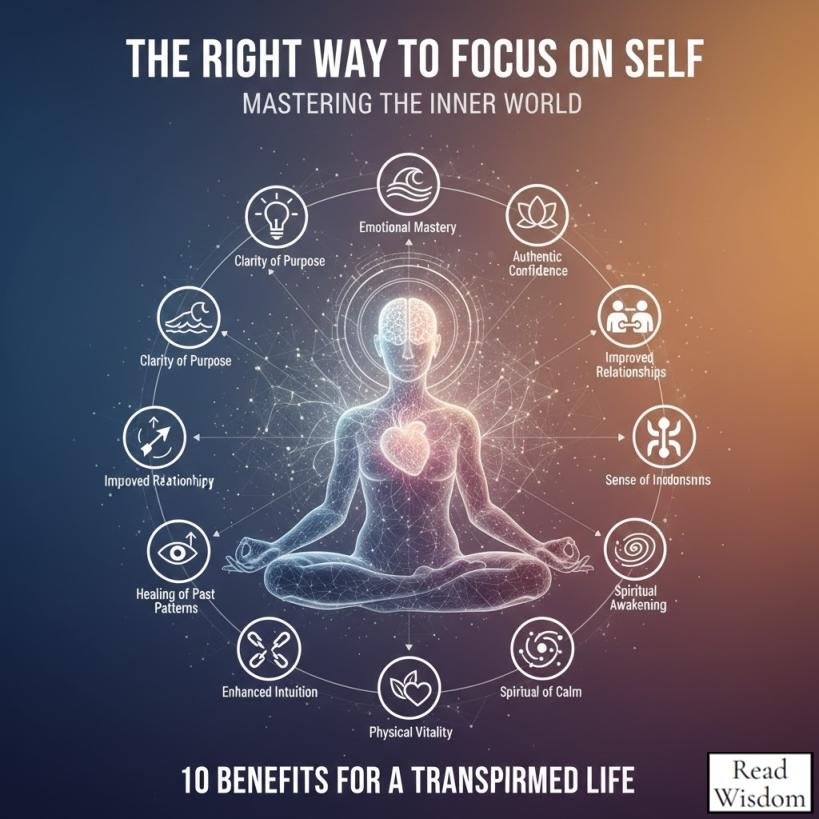
The 10 Benefits of Focusing on Self the Right Way
When practiced consciously, the art of self-focus can transform every dimension of life—mental, emotional, physical, and spiritual. Here are ten powerful benefits that arise naturally when one commits to this inner cultivation:
1. Clarity of Purpose
Focusing inward reveals what truly matters. Instead of chasing endless goals, you begin to discern which paths align with your deeper purpose. This clarity reduces confusion and increases decisiveness.
2. Emotional Mastery
By observing your feelings rather than being ruled by them, emotional storms lose power. Self-focus teaches regulation, acceptance, and resilience. You respond thoughtfully instead of reacting impulsively.
3. Authentic Confidence
Confidence rooted in self-awareness is unshakable. It’s no longer dependent on praise or comparison. You derive self-worth from your inner values and integrity, not from external validation.
4. Improved Relationships
Ironically, focusing on self improves how we relate to others. When you understand your boundaries and emotions, you communicate more clearly and listen with empathy. Healthy relationships grow from self-understanding, not self-neglect.
5. Greater Productivity
When your mind is centered, distractions fade. You channel energy into meaningful work rather than scattered effort. Self-focus boosts concentration, creativity, and flow.
6. Healing of Past Patterns
Awareness shines light on repeating emotional patterns and subconscious programming. This awareness is the first step toward healing childhood wounds and conditioned fears that often drive adult behavior.
7. Enhanced Intuition
The more you tune inward, the stronger your intuitive voice becomes. Decisions that once seemed uncertain begin to feel guided by inner knowing. Intuition is the spiritual intelligence of self-awareness.
8. Physical Vitality
Stress reduction, mindful eating, adequate rest—these naturally follow when one listens to the body with respect. Focusing on self holistically revives energy and strengthens immunity.
9. Sense of Inner Calm
As you detach from comparison and chaos, peace arises organically. The world remains unpredictable, but your center becomes unshakable. You learn to “sit within yourself” calmly, no matter the external noise.
10. Spiritual Awakening
Ultimately, to focus on self is to meet the divine essence within. It’s realizing that consciousness itself is the foundation of experience. Spiritual awakening is not escape—it is the realization that the inner self and universal intelligence are one.
Integrating Self-Focus into Daily Life
Spiritual wisdom is meaningful only when lived in ordinary moments. Integrating self-focus into modern lifestyles requires conscious micro-practices—small but consistent acts that align you with inner awareness.
- Morning grounding: Before checking your phone, take a quiet moment to breathe, journal, or express gratitude.
- Mindful work: Every few hours, step away from screens and return your attention to your breath.
- Digital boundaries: Choose times to disconnect from online noise and reconnect with yourself.
- Evening reflection: Before sleeping, review your day—not with judgment, but gentle observation. What emotions guided you? What lessons surfaced?
These habits don’t just build discipline; they build presence. Over time, your default mode shifts from reacting to consciously being.
The Spiritual Essence Behind Focusing on Self
Spiritual researchers across traditions agree on one truth: self-awareness is the foundation of all higher consciousness. The process of focusing on self, practiced sincerely, dissolves illusions of separation. You begin to perceive that peace, love, and clarity were never outside of you—they were merely obscured by noise.
To live with self-focus is to live awake. It is to move from chaos to coherence, from distraction to divine alignment. The journey requires patience, honesty, and compassion—but its rewards ripple outward, touching every aspect of life.
When more individuals awaken to this balance of self-awareness and service, the collective consciousness transforms. The world does not need more self-centeredness; it needs more self-realized beings.
So, the next time you feel disconnected, overwhelmed, or uncertain—pause. Breathe. Turn inward. Remind yourself that focusing on self, the right way, is not stepping away from life but stepping deeper into its truth.