Human history is a continuous story of exploration — not just of continents and stars, but of inner worlds and unseen possibilities. Every meaningful discovery, whether scientific, artistic, or spiritual, began with a spark of courage: the willingness to try new things. Yet, so many of us hesitate when faced with the unknown. We fear failure, ridicule, or discomfort. What we often forget is that true growth — personal, professional, and spiritual — is inseparable from courage and hope.
The act of being hopeful and fearless enough to experiment with new possibilities is not simply a personality trait; it’s a spiritual discipline. It is an inner posture that connects us with life’s unfolding intelligence, reminding us that creation itself is a living experiment — a dance between risk and revelation.
The Spiritual Nature of Hope
Hope is not naive optimism. It is a quiet inner conviction that something meaningful can emerge, even from uncertainty. In spiritual traditions across the world — from the Bhagavad Gita to the teachings of the Stoics, from Sufi poetry to modern mindfulness — hope is seen as a bridge between the known and the unknown.
When we feel hopeful, we are not ignoring reality; we are extending our awareness beyond its immediate boundaries. Hope acknowledges fear but chooses faith. It doesn’t say “everything will go my way,” but rather “something good may unfold, even if I can’t see it yet.”
To be hopeful is to attune ourselves to the creative rhythm of life — a rhythm that constantly invites renewal. Every sunrise is nature whispering: “Start again.” Hope, in this sense, is the soul’s way of staying aligned with life’s regenerative essence.
Fear — The Silent Inhibitor of Growth
Fear is an evolutionary companion. It protects us from danger, but left unchecked, it also prevents growth. Spiritually speaking, fear stems from attachment — attachment to identity, comfort, control, and predictability. We resist trying new things because our ego finds safety in repetition.
Yet, stagnation disguised as safety is one of the most subtle forms of suffering. When we refuse to move forward, life begins to feel mechanical, our creativity dulls, and our sense of wonder fades.
Fear often masquerades as logic: “It’s not the right time.” “What if I fail?” “What will people think?”
But underneath these rationalizations lies a deeper truth — a disconnection from trust. To try new things fearlessly doesn’t mean being reckless; it means allowing trust to guide action. It means accepting that failure, too, can be sacred, because it refines awareness and strengthens resolve.
Courage as an Expression of Consciousness
From a spiritual researcher’s lens, courage is not the absence of fear but the transcendence of it through awareness. Courage arises when we realize that our identity is not confined to our failures or successes. When consciousness expands beyond temporary roles and labels, experimentation feels natural.
Children instinctively embody this wisdom. They touch, taste, explore, fall, and rise again without overthinking. Their openness reflects the unconditioned state of consciousness before social fears take root. As spiritual adults, our journey is about reclaiming that innate permission to explore, but with awakened awareness.
Every time we choose to try new things — whether learning an instrument, starting a business, or simply altering a daily routine — we affirm life’s dynamic flow. We say to the universe: “I am willing to co-create with you.” This co-creative stance is deeply spiritual because it honors life as a partnership rather than a test.
The Intersection of Hope and Action
Hope without action is like a lamp without oil — beautiful in form but dormant in effect. True hope demands engagement. When we act from a hopeful heart, each small step becomes a declaration of faith in the unfolding goodness of existence.
Spiritual growth and personal transformation require this interplay between inward faith and outward experimentation. To meditate, to travel, to switch careers, to express creativity — all demand faith that stepping into the unknown may lead to expansion.
Consider the humble seed. Buried in darkness, it doesn’t know what sunlight feels like. Yet it moves upward, guided by an invisible instinct. That upward push is hope in motion. We, too, are seeds of infinite potential, drawn toward light, guided by something unseen yet profoundly real.
Overcoming the Illusion of Control
One of the greatest spiritual realizations in trying new things is confronting our illusion of control. Much of our fear comes from wanting life to unfold according to our design. But the deeper we investigate consciousness, the clearer it becomes that authenticity thrives not in control but in alignment.
To align with life is to recognize that outcomes are not fully ours to dictate — but our intentions and efforts are. A person who is hopeful acts from sincerity, not guarantee. Whether the result brings success or failure, such a person sees both as teachers.
Zen philosophy often emphasizes the “beginner’s mind” — an attitude of openness, curiosity, and nonattachment. This mindset encourages us to engage each experience as if seeing it for the first time, without clinging to past knowledge or future anxieties. Trying new things with such awareness turns the act itself into meditation.
Failure as a Spiritual Teacher
Many avoid experimenting out of fear of failure. Yet, failure is one of life’s most profound spiritual teachers. It dismantles ego, tests humility, and redirects us toward deeper authenticity. When approached with awareness, failure is not an enemy but an initiation.
Each time something doesn’t go as planned, we are invited to examine whether our motivation came from insecurity, desire for validation, or genuine curiosity. From this reflection emerges wisdom — a treasure that cannot be learned theoretically. Experience chisels the soul in ways no book can.
Being hopeful amidst failure means trusting that even apparent setbacks carry hidden blessings. A closed door is often a redirection; a pause may be preparation. The spiritually mature mind sees beyond surface appearances to the larger, benevolent intelligence working behind events.
The Hopeful Mindset in Daily Life
Developing a hopeful and fearless mindset doesn’t require grand gestures. It begins with small, conscious experiments in daily living.
Try a new morning routine. Eat something unfamiliar. Speak kindly where you once reacted harshly. Read beyond your comfort zone. Engage with someone whose worldview differs from yours. Each small act of openness reconditions the nervous system, expanding our capacity for flexibility and joy.
As these small acts accumulate, you’ll notice subtle inner transformations:
- Your tolerance for uncertainty increases.
- Your compassion toward yourself and others deepens.
- Your creativity becomes fluid rather than forced.
- Most importantly, life begins to feel alive again — unpredictable, yes, but beautiful in its unfolding.
Hope is strengthened each time we face fear and move anyway. It is through such mindful movement that we reclaim agency from fear’s grip.
Trying New Things as a Path to Self-Discovery
Every new experience reveals a previously hidden aspect of ourselves. We discover latent talents, forgotten passions, or even unexamined fears. Trying new things becomes a mirror — reflecting both our potential and our limitations with equal clarity.
From a spiritual standpoint, this process of expansion is not about becoming someone new but remembering who we truly are: consciousness exploring itself through form and experience. Each fresh endeavor adds nuance to this remembering.
When we allow life to flow through us in this way, being hopeful and fearless to try new things becomes not just self-improvement but self-realization. It is a living meditation on impermanence, freedom, and trust in the larger mystery of existence.
A Living Conclusion: The Adventure of Becoming
To live spiritually is to live experimentally. It is to say “yes” to life’s invitations, even when they come disguised as uncertainty. Being hopeful keeps our hearts supple; being fearless keeps our spirits free. Together, they form the key to authentic living.
When we stop fearing change, we stop resisting life. When we choose to try new things, we affirm our divine right to evolve. And when we remain hopeful through it all, we walk hand in hand with the very creative force that animates the universe itself.
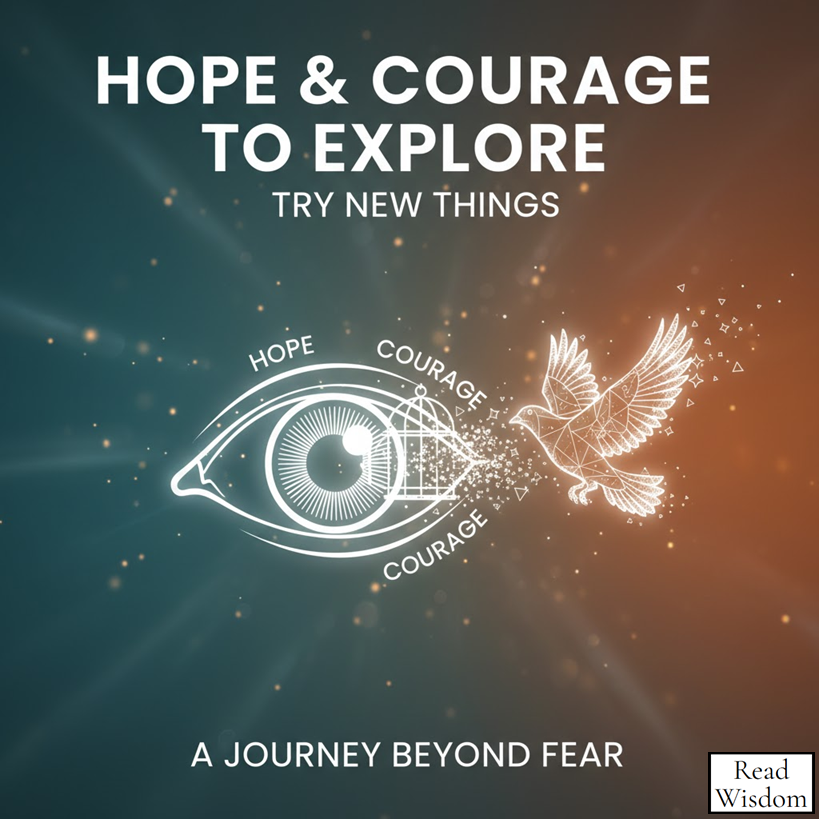
Ultimately, hope and courage are not separate virtues — they are two wings of the same bird, enabling the soul to fly toward its fullest expression. Each time we take flight, we participate consciously in the eternal adventure of becoming.