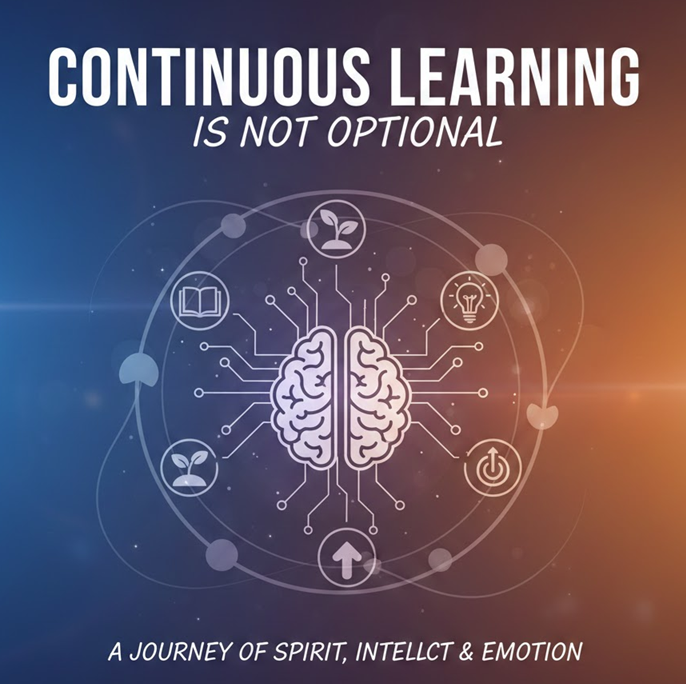
In a world that evolves at the speed of thought, the idea of continuous learning has transcended professional strategy. It is now a spiritual, intellectual, and emotional necessity. Just as breathing sustains the body, learning sustains the soul. To pause in learning is to pause in living—to deny the flow that life itself generates through experience, awareness, and transformation.
Throughout human history, civilizations that flourished were those guided by curiosity and adaptability. From the monasteries of ancient Nalanda to the thinkers of the Renaissance, knowledge was never considered static. It was dynamic, alive, a sacred current that carried humanity from ignorance toward illumination. Yet in the modern era—where information surrounds us like air—we risk mistaking availability for understanding. The truth is, continuous learning is not optional at all because change does not wait for our consent. It flows whether we move with it or not.
The Spiritual Foundation of Learning
At its essence, learning is not about accumulation—it is about awakening. Every spiritual tradition, whether Eastern or Western, speaks of this inner unfolding. The Upanishads describe true wisdom as “that which makes one see unity in diversity.” Taoist philosophy calls it wu wei—aligning with the natural flow. Even Christ’s parables suggest an open mind, a willingness to see beyond one’s own limits. All these teachings point toward a central insight: learning is the continuous expansion of consciousness.
When we say continuous learning, we often think of courses, skill updates, or professional certifications. But from a spiritual perspective, it means something deeper—an ever-renewing relationship with life itself. Every conversation, failure, joy, or obstacle becomes a teacher. To stop learning is to stop listening to life’s whispers—the subtle hints that point us toward growth.
The mystic Jiddu Krishnamurti once remarked, “To learn is to change. To learn is to observe without conclusion.” This statement unveils the core of spiritual inquiry. Learning thrives where there is humility, not pride; presence, not impatience. The path of growth demands that we admit our ignorance, which is perhaps the most courageous spiritual act of all.
Why Continuous Learning Defines Modern Evolution
From a more worldly lens, the digital revolution has expanded the horizon of learning beyond any previous generation’s imagination. Artificial intelligence, biotechnology, climate science, digital economies—every field is morphing continuously. Skills that were relevant yesterday may become obsolete tomorrow. To thrive in the 21st century, adaptability isn’t merely a helpful trait—it is survival itself.
However, beyond survival lies awakening. The same neural plasticity that adapts us to new tools and ideas is the scientific evidence of a deeper truth: we are designed to evolve. The human brain never stops reshaping itself in response to learning. What mystics once felt intuitively—that growth is infinite—neuroscience now visualizes through synapse and structure.
So, when someone says “I’ve learned enough,” they are denying their very biology. They are freezing a river that exists to flow.
Professionally too, the cultures that succeed are learning cultures. Think of organizations like Google or Toyota, where feedback loops, experiments, and open inquiry form the bloodstream of innovation. Each project, success, or setback becomes an opportunity to refine understanding. In this sense, continuous learning is not simply a corporate value—it is a living reflection of the cosmic principle of impermanence, expressed through human creativity.
Learning as Energy Transformation
Let’s shift the lens again, into the subjective realm of consciousness.
Energy—be it emotional, intellectual, or spiritual—must circulate to stay vibrant. Stagnant energy decays. In yoga, this principle is embodied through movement and breath; in Zen, through mindfulness. Similarly, learning keeps mental and spiritual energy circulating. When we expose ourselves to new ideas, we challenge our mental rigidity, dissolve outdated beliefs, and renew emotional resonance.
Continuous learning therefore is not only about feeding the mind. It is about maintaining the flow of subtle energy through awareness. Every new insight increases the voltage of understanding; every creative application of that learning radiates new potential into the world. The act of learning becomes a silent meditation—an alignment with the universe’s expanding nature.
When life itself is an ongoing act of creation, to learn continuously is to remain aligned with that creative pulse. The great Indian sage Sri Aurobindo wrote, “Life is life—whether in a cat or a human or a tree—the same energy flowing through all forms.” Our learning connects us to that energy, allowing us to participate consciously in evolution instead of resisting it.
The Ego’s Resistance to Learning
If learning is so natural and vital, why do people so often resist it? Because learning threatens the ego’s illusion of certainty. Every new idea is a gentle death to what we thought we knew. It shakes our self-image and asks us to let go.
Spiritually, this is the crux of transformation. Growth and comfort cannot coexist. This is why continuous learning is also a dissolving process—an unlearning of false stability. The ego wants definition; the soul seeks discovery. The more we identify with our existing knowledge, the more we resist expansion. True learners cultivate what Zen masters call shoshin, or “beginner’s mind”—a posture of curiosity, humility, and openness.
This mindset is not passive naivety. It is active awareness—the recognition that even what we know can always deepen in perspective. The wise never declare finality; they declare readiness.
Continuous Learning in the Age of Noise
In an age of endless information, it’s easy to confuse scrolling for learning and opinion for wisdom. The spiritual researcher must therefore discriminate between input and insight. Continuous learning in the digital era requires mindfulness. One must break away from the superficial consumption of facts and instead absorb ideas at the level of transformation.
It means pausing after reading, reflecting on implications, testing them in life. It means that knowledge must travel from intellect to intuition. A byte of information is only potential wisdom—it becomes alive only when it reshapes how we see ourselves and the world.
Thus, true continuous learning is rhythmic. It flows between intake and silence—between acquiring and integrating. It honors both study and stillness. The learner turns inward after exploration, letting new understanding settle like soil after rain.
Creating a Culture of Continuous Learning
At a collective level, societies thrive when they create ecosystems that encourage curiosity over conformity. Education systems must move from memorization toward exploration. Workplaces must reward reflection as much as execution. Homes must nurture questions, not just answers.
We often glorify productivity, but in truth, productivity without learning is mechanical. A culture that stops learning becomes rigid—unfit to adapt to crisis. Just as muscles atrophy from disuse, so does the collective mind without renewal.
Building a learning culture means cultivating a safe space for experimentation and admitting mistakes without shame. It asks leaders to model vulnerability—to say, “I don’t know, but I’m ready to learn.” The ancient spiritual teachers knew this: only those who bow to the unknown can truly rise in wisdom.
Learning as a Path of Liberation
Ultimately, continuous learning leads not merely to competence, but to freedom. Ignorance confines; understanding expands. The more we learn—about the world, others, and ourselves—the less we fear uncertainty. Learning dissolves the walls of separation between “me” and “them,” “known” and “unknown.” Each insight opens a window, and through these openings, light enters.
The Bhagavad Gita calls such wisdom jnana, knowledge that liberates. When learning reaches this dimension, it ceases to be an activity and becomes awareness itself. Then every challenge transforms into a teacher, every ending into a lesson, and every moment into a field of exploration.
In this sense, continuous learning mirrors the journey of spiritual awakening: an unending movement toward greater wholeness. Where the ego sees finality, the soul sees infinite potential. To keep learning is to participate consciously in that unfolding infinity.
Conclusion: The Learner’s Vow
We live in a time when adapting is no longer optional—it is sacred duty. Continuous learning is the bridge between the finite and the infinite, between the person we are and the one we can become. It keeps us porous to life, alive to wonder, humble before reality’s vastness.
To learn continuously is to affirm faith in evolution—of matter, mind, and spirit. The learner’s vow, then, is simple but profound: to remain open. Open to being wrong. Open to being surprised. Open to the wisdom that awaits beneath every question.
For in the end, the universe itself is a learner, endlessly discovering new ways to express its eternal truth through us.