In a world dominated by constant motion, endless notifications, and a near-permanent sense of urgency, the ability to remain calm, cool, and collected isn’t a small achievement—it’s a spiritual discipline. This timeless phrase doesn’t just describe a state of emotional poise; it reflects an inner harmony that balances the turbulence of life with the depth of one’s inner stillness. But what does it really take to cultivate that serenity? Let’s explore this through the combined lenses of psychology, consciousness, and practical spiritual practice.
Understanding the Triad: Calm, Cool, and Collected
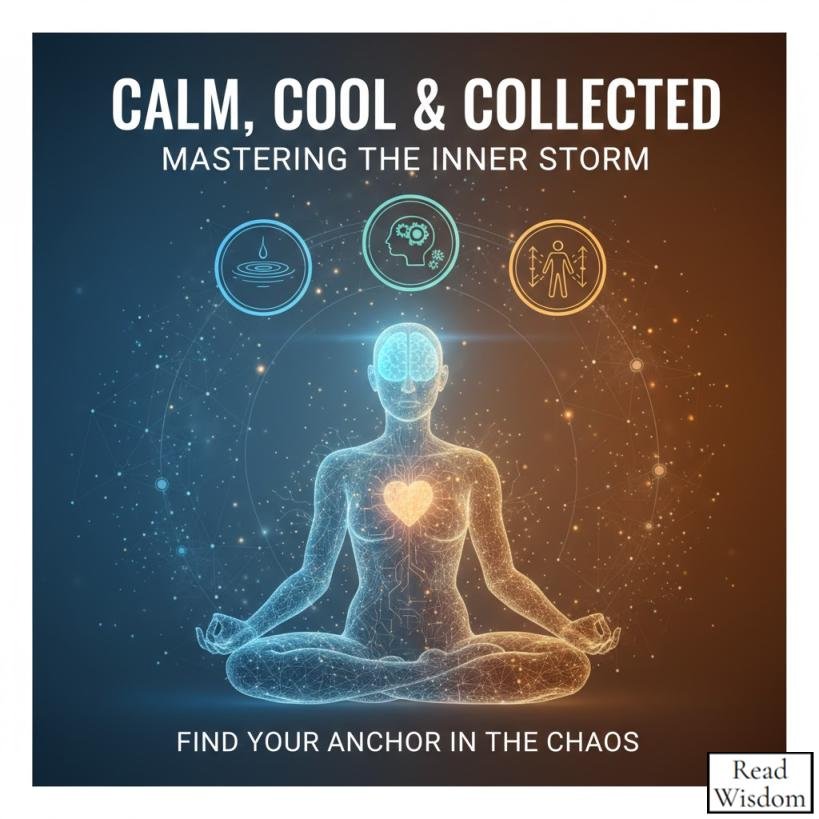
The phrase calm, cool, and collected might sound like a cliché of composure, but each word represents a distinct state of inner being:
- Calm refers to emotional stability—the quiet waters of the mind even when external storms rage.
- Cool points to rational clarity and emotional detachment; it’s the mental poise that helps you see situations without the blur of immediate impulse.
- Collected embodies self-awareness and integration—being grounded enough to gather your thoughts, emotions, and actions into focused purpose.
Together, these qualities form the foundational triad of personal mastery. It’s not about indifference or suppression of emotions, but about refining your relationship to internal and external stimuli.
The Inner Turbulence: Why Calm Feels So Distant
Before exploring how to become calm, we must understand why calm seems so difficult to maintain in modern living. Our nervous systems are overstimulated by perpetual information flow—emails, breaking news, personal anxieties, and even anticipated stress. We are, in essence, constantly “vibrating” with emotional noise.
Psychologically, the human brain evolved to detect threats, not peace. The amygdala, our threat-detection center, often overrides the logical prefrontal cortex when stress triggers arise. Spiritually, this manifests as disconnection—not from the world, but from our own center.
Being calm, cool, and collected therefore requires a conscious recalibration of our attention. It is not achieved through external control, but through an inner attunement to silence—what many spiritual traditions call “the still point.”
Stillness as a Spiritual Technology
The idea of stillness is ancient and transcultural. In Buddhist practice, it appears as shamatha—calm-abiding meditation, the art of resting awareness in the present moment. In Stoic philosophy, it shows up as ataraxia—a state of untroubled mind. And in Christian mysticism, the same essence is known as hesychia—holy stillness or inner quiet.
What all these traditions share is the understanding that calm is not laziness or lack of activity. It is the presence of awareness without turbulence. To cultivate a calm, cool, and collected mind, one must first learn to witness one’s thoughts. Over time, you realize that thoughts are clouds, not the sky; emotions are waves, not the ocean itself.
Stillness doesn’t mean that waves cease to exist—it means you identify more with the ocean than the waves. From that vantage point, even life’s fiercest storms lose their grip on you.
Emotional Regulation: The Psychological Path to Calm
There’s a science-backed side to all this too. Emotional regulation strategies—such as mindfulness, cognitive reframing, and diaphragmatic breathing—mirror ancient spiritual techniques. These practices strengthen the prefrontal cortex, improve vagal tone, and reduce amygdala hyperreactivity.
To become calm, you must create a buffer between stimulus and response. Viktor Frankl, the Holocaust survivor and psychiatrist, famously observed: “Between stimulus and response there is a space. In that space is our power to choose our response.” That space is where “coolness” lives—it’s the breath between reaction and wisdom.
When we consciously inhabit that space, we remain collected even amid provocation. Instead of becoming a passenger of emotional energy, we become its navigator.
The Role of Self-Awareness and Reflection
Being collected implies inner coherence—when your thoughts, emotions, and actions are aligned. Without self-awareness, our mental energy scatters; with it, we gather our focus like a lens concentrating light.
Daily reflection, journaling, or quiet walks without distraction can bring this coherence back. Asking simple questions like, What am I feeling right now? Why am I feeling it? What might this teach me? transforms emotion into insight. Over time, this radical honesty clears the fog that clouds judgment.
Self-awareness also humbles us. We begin to see how our egos construct dramatic narratives—how a simple delay becomes a “disaster,” how a small comment becomes “insult.” Once we step outside these egoic stories, calm arises naturally. It is not attained, but revealed.
Detachment Without Indifference
Many people mistake being cool and collected for being detached or apathetic. But true detachment doesn’t mean not caring—it means caring without clinging. It’s about engagement free from emotional turbulence. The Bhagavad Gita describes this as yoga of equanimity—performing one’s duty without attachment to outcome.
In practice, this might mean expressing your emotions authentically but without letting them dictate your decisions. It’s speaking the truth firmly but peacefully. It’s staying open-hearted while grounded in inner certainty.
That’s the paradox: the more grounded and collected you become, the more compassion and clarity you bring into your relationships.
Small Practices That Build Inner Stability
Cultivating calm isn’t an overnight transformation—it’s a daily discipline. Just as physical muscles grow with consistent training, mental steadiness grows through regular practice. You can begin with modest but deeply transformative habits:
- Intentional breathing. Practice deep, rhythmic breathing. Inhale for four counts, hold for two, exhale for six. This naturally slows the nervous system and fosters presence.
- Mindful pauses. Create micro-moments of awareness throughout the day. Before answering a message or reacting to frustration, take one conscious breath.
- Digital silence. Set aside time each day free from screens. Let your nervous system reset from overstimulation.
- Morning centering. Begin your day with quiet reflection or meditation before engaging the external world.
- Gratitude journaling. This simple act rewires attention from deficit to abundance, dissolving anxiety into ease.
These daily seeds of stillness gradually accumulate into a more resilient, calm, cool, and collected presence.
The Energy of Equanimity
One of the most profound spiritual realizations is that calmness is an energy—not merely an emotion. When the mind settles, energy redirects inward, fueling creativity, intuition, and empathy. Great leaders, healers, and thinkers have often described this quality. The Buddha called it upekkha (equanimity), while Lao Tzu wrote of “returning to the root,” a calm so deep that wisdom naturally flows.
Equanimity doesn’t eliminate challenges; it transforms how we meet them. It allows us to respond instead of react—to move with precision rather than haste. Even in chaos, a calm person becomes an energy stabilizer for everyone around them. Their presence communicates safety and groundedness beyond words.
The Spiritual Shift: From Doing to Being
Ultimately, to be calm, cool, and collected isn’t about adding new techniques or achievements—it’s about unlearning reactivity and returning to your natural state of awareness. You cannot force calmness; you can only allow it. It emerges when you stop fighting life and start observing it with trust.
This shift is subtle but profound. The ego thrives on doing, controlling, and fixing, while calmness belongs to the realm of being. In still awareness, you no longer need to prove or defend anything. Life moves through you effortlessly. You become centered, like the still axis around which all experience turns.
When Calm Becomes Strength
It takes courage to remain calm in a reactive world. It takes maturity to stay cool while others rage and patience to stay collected when everything seems scattered. Yet this composure is not weakness—it is mastery. It is the quiet confidence of someone who knows the storms cannot drown them because they have already found the shore within.
To be truly calm, cool, and collected is to be deeply alive, aware, and free. It means owning your inner atmosphere no matter how unpredictable the outer weather may be. And in that ownership, you rediscover one of the rarest forms of power—the power to remain yourself in any situation.